
Triangular acoustic cluster with ultrasonic synchronization to geolocate Iberian orcas at the tuna traps of the Cádiz coast.
The Iberian orca (Orcinus orca) of the Strait of Gibraltar is a genetically distinct subpopulation with barely 40 confirmed active individuals, listed as critically endangered. Its ecology is tied to bluefin tuna: during the fishing season (May–July), orcas approach the Cádiz tuna traps (almadrabas) to prey on tuna, producing interactions that until now had only been studied from a single listening point.
A recurring observation from the almadraba fishermen is that orca presence coincides with an increase in tuna entering the trap — possibly because orcas, while chasing shoals in shallow water, unintentionally drive them toward the net structure. SyncPulser was built to gather quantitative evidence for this hypothesis: two triangular clusters of autonomous hydrophones, internally synchronized by ultrasonic pulses, geolocate orcas acoustically for the first time in this setting, correlating their position and vocal behaviour with tuna entry rates and aerial drone observation.
The project is a collaboration between the Universidad de La Laguna (ULL, scientific direction and bioacoustic analysis), CIRCE (Conservation, Information and Research on Cetaceans — 25 years of research in the Strait) and Medusa IoT, responsible for designing and building the sync emitters and integrating the embedded sensing.
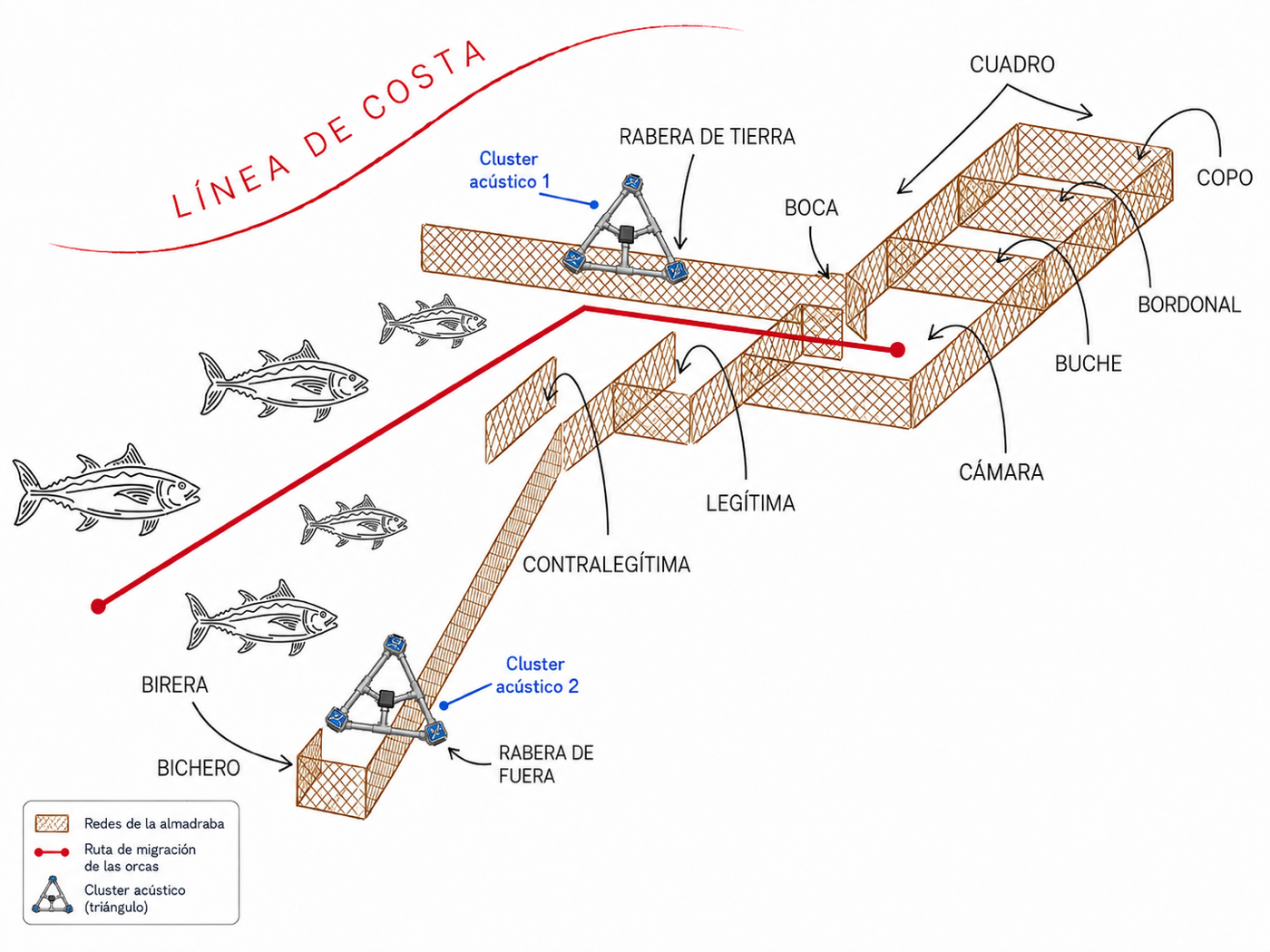
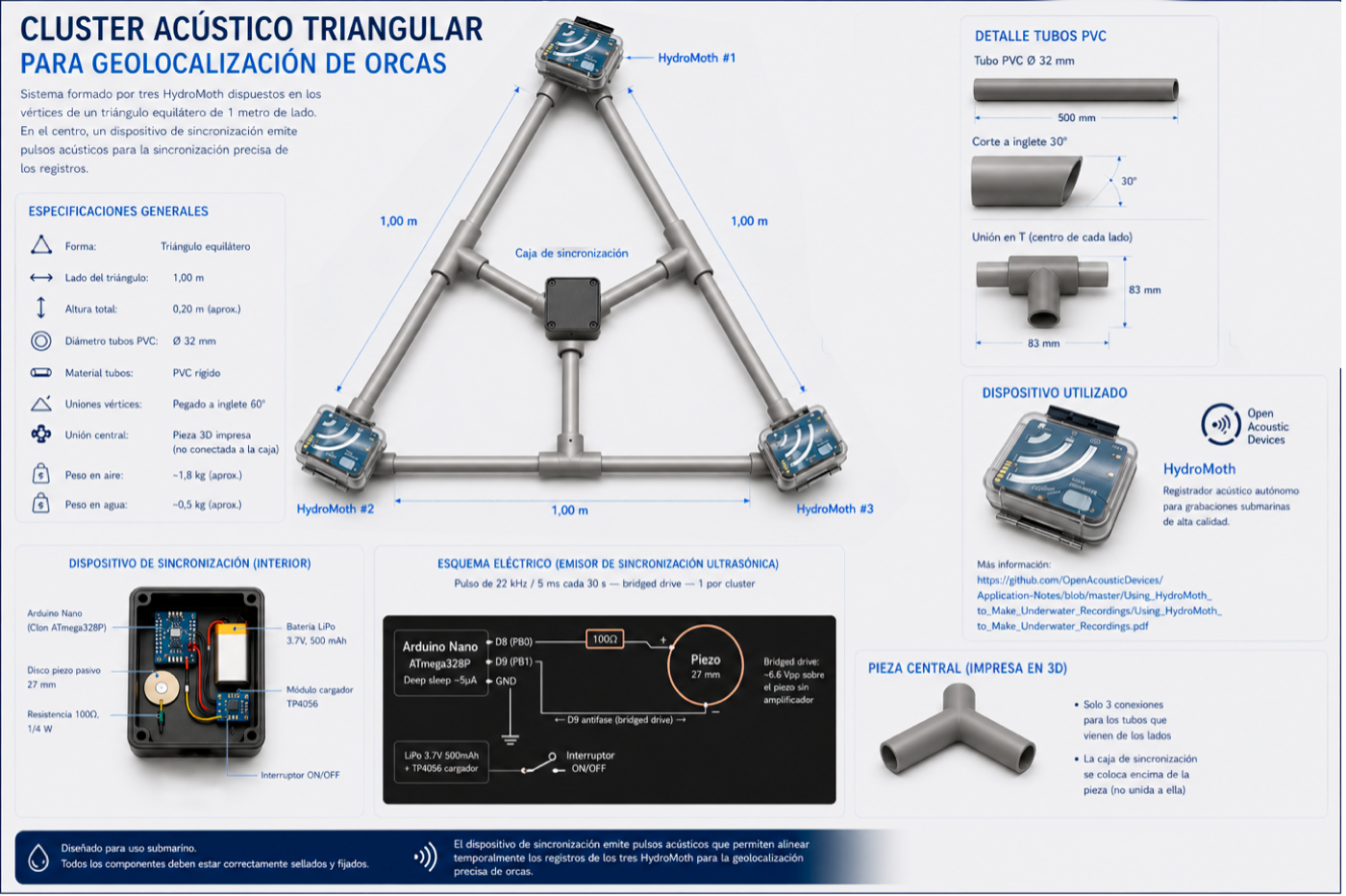
The system is organized into two triangular clusters of three HydroMoths each (1 m equilateral triangle), separated by 300–400 metres, plus a calibrated SoundTrap recorder as reference in the trap's copo chamber. Each cluster determines a vocalization's bearing via TDOA (time difference of arrival) between its three hydrophones; the intersection of both clusters' bearings gives the source's 2D position by classic triangulation.
This architecture greatly simplifies synchronization: only the three hydrophones within each cluster need to be synced, not across clusters. Each cluster is a self-contained, manageable unit, and bearing-intersection geolocation is robust against inter-cluster sync errors.
The HydroMoth (Open Acoustic Devices) is the aquatic version of the AudioMoth, a low-cost autonomous recorder for acoustic ecology. It's set to 48 kHz because the orca vocal repertoire — tonal social calls (1–6 kHz) and whistles (3–18 kHz) — sits entirely within the recording bandwidth (Nyquist at 24 kHz), without the extra cost and power draw of a wider-band recorder.
Each unit runs on 3 Energizer Ultimate Lithium AA cells (24% more runtime than alkaline, with enough voltage margin above the AudioMoth's minimum threshold) and stores to a 64 GB SanDisk Extreme, enough for ~9 days of recording at a 5:1 duty cycle at 48 kHz.
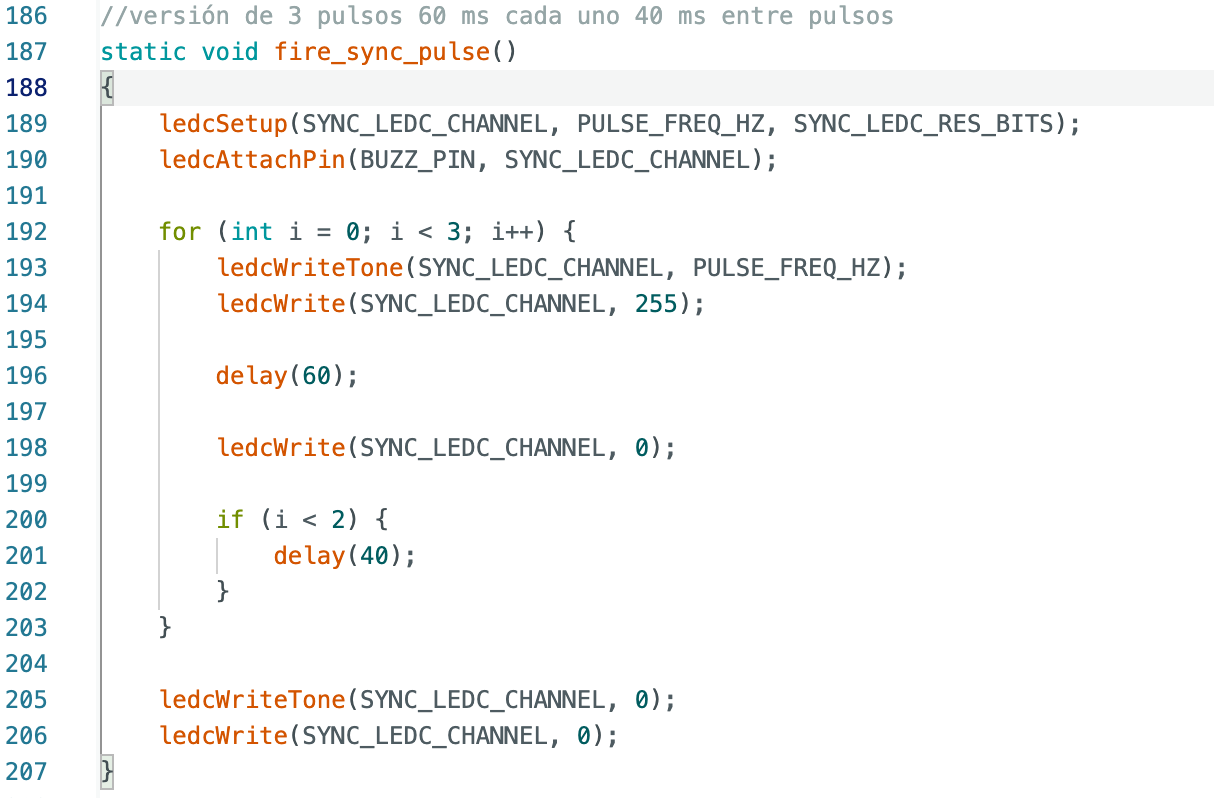
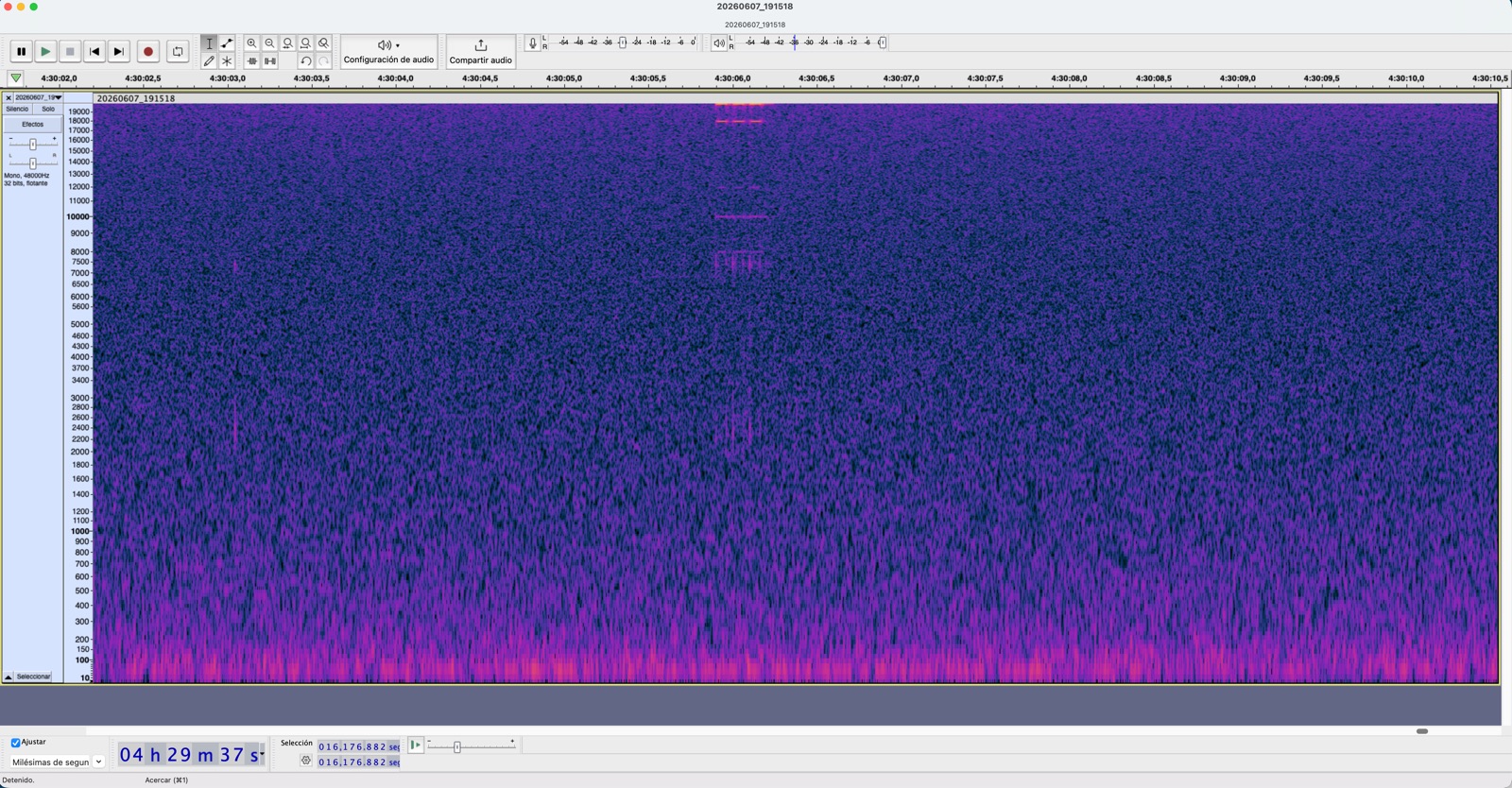
HydroMoth's quartz oscillators drift 2–5 ppm, accumulating up to 4 seconds of error over an 8-day deployment. At the speed of sound in water (~1,520 m/s), a 1 ms error alone equals 1.52 m of position uncertainty. The fix: a 27 mm piezoelectric emitter at the geometric center of each triangle fires a 22 kHz pulse every 30 seconds — outside the orca vocal range (1–18 kHz) but within the recording bandwidth — which all three HydroMoths capture, letting the relative drift be corrected in post-processing to ±1 sample (~21 µs at 48 kHz), equivalent to just ±1° of angular error.
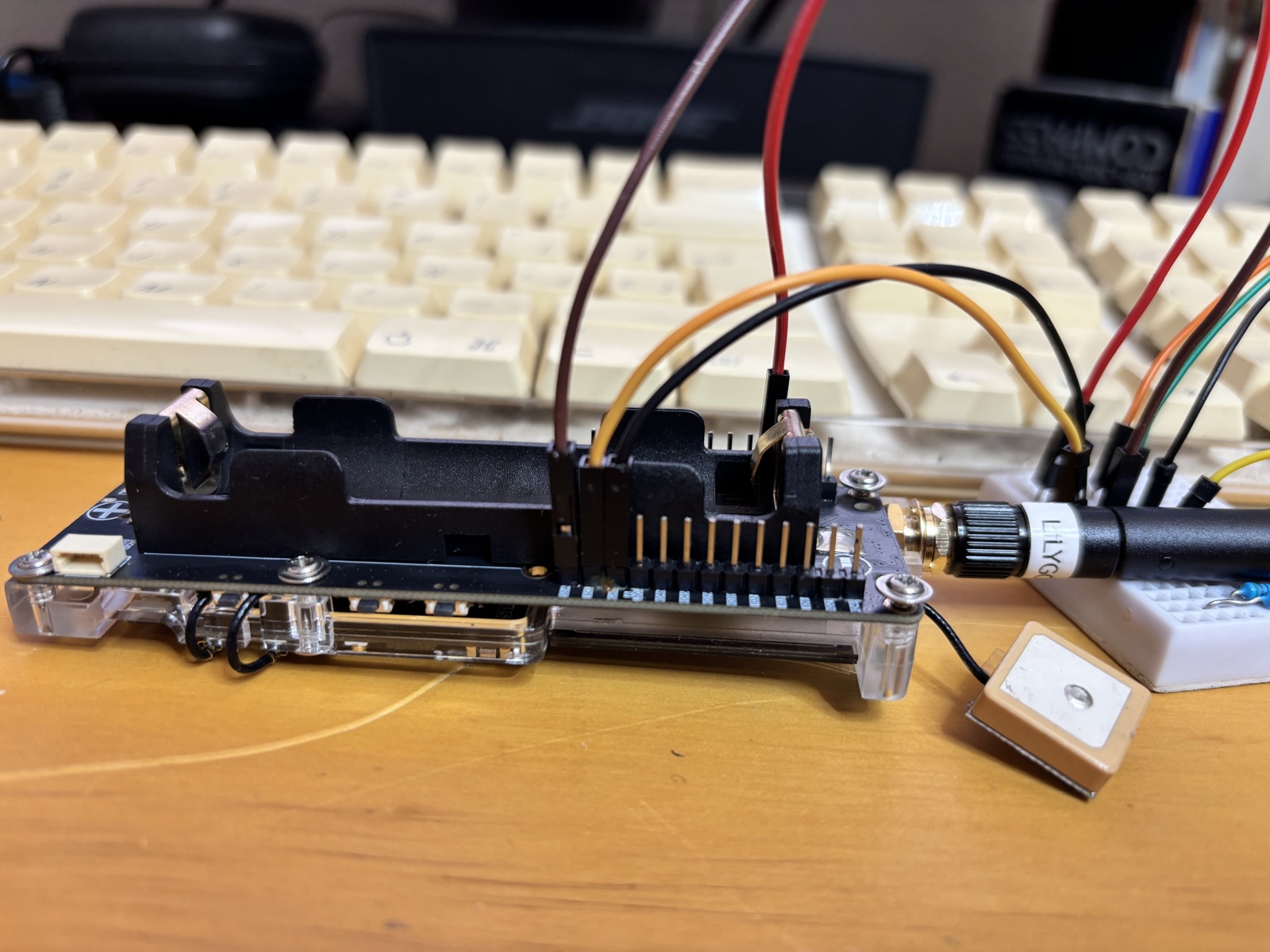
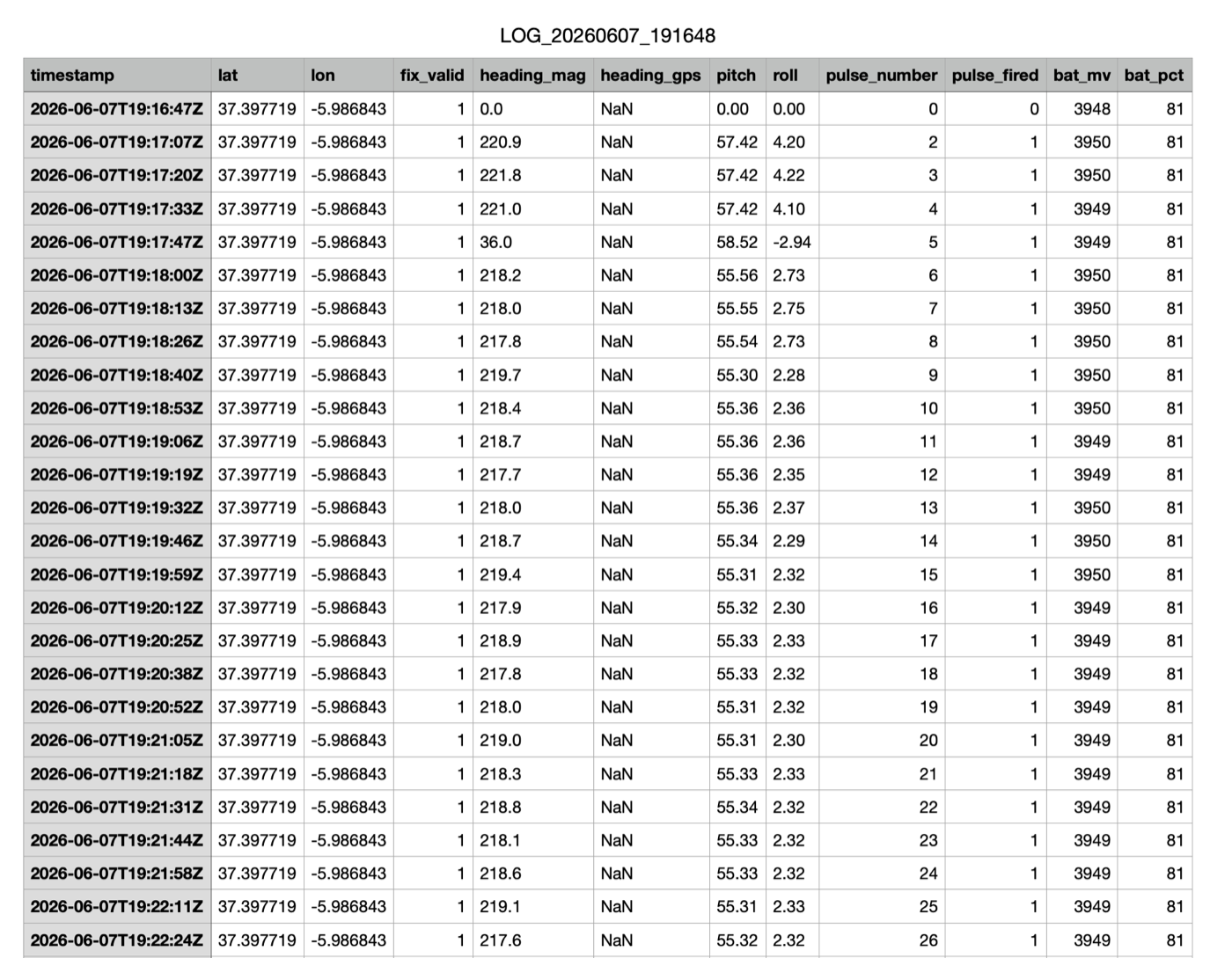
The emitter is driven by a LILYGO T-Beam Supreme board (ESP32-S3), which besides firing the pulse also logs the cluster's orientation to its SD card — heading, pitch and roll via the QMI8658 IMU and QMC6310 magnetometer — with a GPS timestamp every 2 seconds. The pulse acts as a temporal bridge between the HydroMoth's clock (WAV) and the T-Beam's GPS clock: in post-processing, each pulse is detected by cross-correlation, matched to its PULSE line in the CSV, and absolute_bearing = TDOA_relative_bearing + cluster_heading is computed.
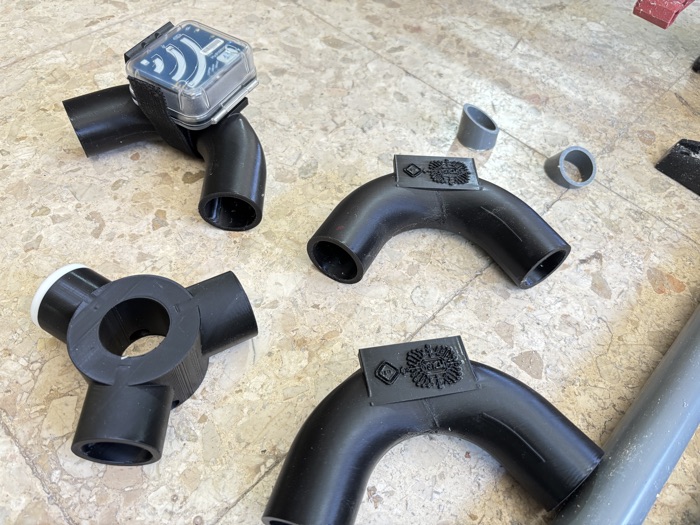
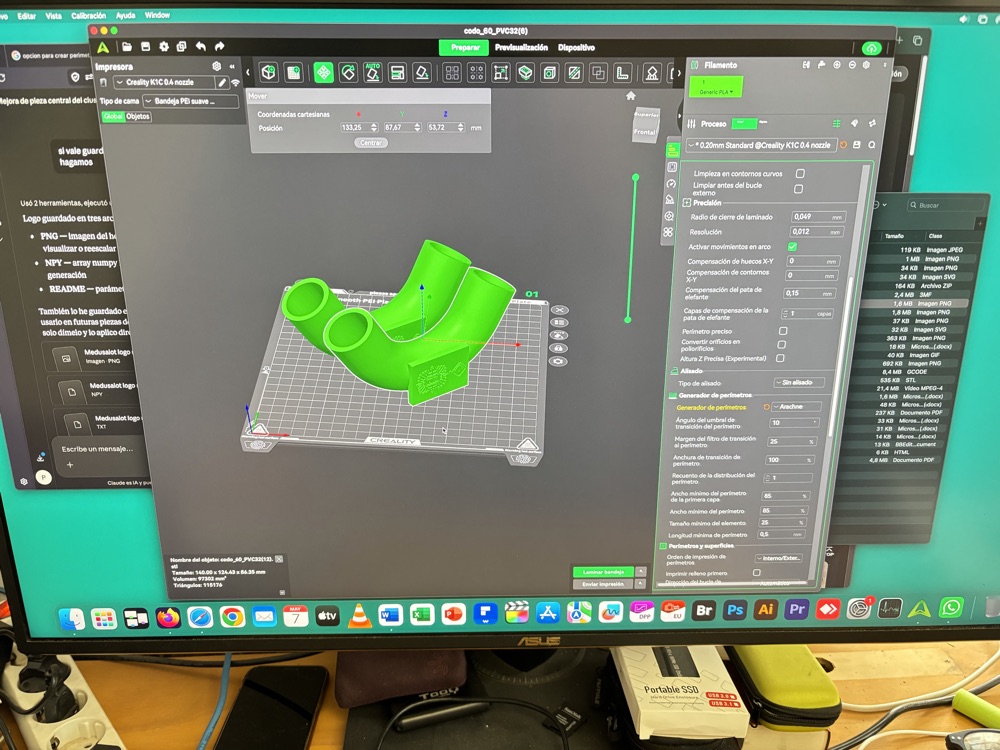
The frame is an equilateral triangle of 32 mm pressure-rated PVC pipe (PN10), with the three 1,000 mm sections mitered at 30° and solvent-welded. A PVC T-fitting sits at the midpoint of each side, with a short pipe running to the center; the three radial pipes converge on a 3D-printed center piece with three ports at 120°, made in PPA-CF (carbon-fiber reinforced polyamide) for its hydrolysis resistance and dimensional stability in salt water.
The emitter's watertight enclosure — also 3D-printed — houses the T-Beam Supreme, the 18650 battery and the piezo, sealed with an NBR O-ring and heat-set M3 inserts. Each HydroMoth hangs from a vertex via an AISI 316 carabiner, a polypropylene line and a 0.5 kg ballast weight. The assembly is validated with a buoyancy test and a 2-hour freshwater watertightness test before each deployment.
Bench tests on June 6–7, 2026 logged the emitter running continuously for several hours: valid GPS fix, heading/pitch/roll sampled roughly every 13 seconds, confirmed pulse firing on every cycle (pulse_fired = 1) and a stable battery voltage around 3,949–3,950 mV (81%) across the whole log.
The spectrogram from one of the HydroMoth recordings confirms the sync pulses are clearly detectable above ambient noise, appearing as three short vertical marks around 18–19 kHz — just below the 24 kHz Nyquist limit and outside the orca vocal range.
For each vocalization, the time differences of arrival between a cluster's three hydrophone pairs (A-B, A-C, B-C) are obtained via generalized cross-correlation with phase transform (GCC-PHAT), determining the sound wave's angle of incidence. With a 1 m triangle at 48 kHz, the theoretical angular resolution is 4–6° for tonal orca vocalizations, enough to triangulate at the array's distances (300–500 m), with an estimated position precision of ±10–30 m.
Pairing the same vocalization detected by both clusters doesn't require inter-cluster synchronization: a temporal proximity window (±2 s) and spectral similarity between detections are enough. Each georeferenced vocalization accumulates over days or weeks to build heat maps of acoustic activity over the trap's layout, identifying the orcas' preferred zones and correlating them with tuna entry rates.